Tilapia grow well at high densities in the confinement of tanks when good water quality is maintained. This is accomplished by aeration and frequent or continuous water exchange to renew dissolved oxygen (DO) supplies and remove wastes. Culture systems that discard water after use are called flow-through systems while those that filter and recycle water are referred to as recirculating systems.
Intensive tank culture offers several advantages over pond culture. High fish density in tanks disrupts breeding behaviour and allows male and female tilapia to be grown together to marketable size. In ponds, mixed sex populations breed so much that parents and offspring compete for food and become stunted. Tanks allow the fish culturist to easily manage stocks and to exert a relatively high degree of environmental control over parameters (eg, water temperature, DO, pH, waste) that can be adjusted for maximum production. With tanks, feeding and harvesting operations require much less time and labour compared to ponds. Small tank volumes make it practical and economical to treat diseases with therapeutic chemicals dissolved in the culture water. Intensive tank culture can produce very high yields on small parcels of land.
Tank culture also has some disadvantages. Since tilapia have limited access to natural foods in tanks, they must be fed a complete diet containing vitamins and minerals. The cost of pumping water and aeration increases production costs. The filtration technology of recirculating systems can be fairly complex and expensive and requires constant and close attention. Any tank culture system that relies on continuous aeration or water pumping is at risk of mechanical or electrical failure and major fish mortality. Backup systems are essential. Confinement of fish in tanks at high densities creates stressful conditions and increases the risk of disease outbreaks. Discharges from flow-through systems may pollute receiving waters with nutrients and organic matter.
Geographical range
The geographical range for culturing tilapia in outdoor tanks is dependent on water temperature. The preferred temperature range for optimum tilapia growth is 82° to 86° F. Growth diminishes significantly at temperatures below 68° F and death will occur below 50° F. At temperatures below 54° F, tilapia lose their resistance to disease and are subject to infections by bacteria, fungi and parasites.
In the southern region, tilapia can be held in tanks for 5 to 12 months a year depending on location. The southernmost parts of Texas and Florida are the only areas where tilapia survive outdoors year-round. Elsewhere, tilapia must be overwintered in heated water. Flow-through systems are only practical for year-round culture in temperate regions if geothermal water is available. In the winter it would be too expensive to heat water and soon discard it. There has been some promising research on the use of heated effluents from power plants to extend the growing season. Indoor recirculating systems are more appropriate for year-round culture because buildings can be insulated to conserve heat and the heated water is saved through recycling. Indoor recirculating systems have potential for extending the geographical range of tilapia culture throughout the US Systems could be located in urban areas close to market outlets.
Flow-through systems
The most durable tank materials are concrete and fibreglass. Other suitable but less durable materials include wood coated with fibreglass or epoxy paint, and polyethylene, vinyl or neoprene rubber liners inside a support structure such as coated steel, aluminium or wood. Tank material must be non-toxic and noncorrosive. The interior surface should be smooth to prevent damage to fish by abrasion, to facilitate cleaning and to reduce resistance to flow. Both ease and expense of installation are important factors in the selection of construction materials.
Tanks come in a variety of shapes, but the most common forms are circular and rectangular. Raceways are rectangular tanks that are long and narrow. Variations of circular tanks are silos, which are very deep, and octagonal tanks. Circular tanks are very popular because they tend to be self-cleaning. If the direction of the inlet flow is perpendicular to the radius, a circular flow pattern develops which scours solids off the tank bottom and carries them to a centre drain. Rectangular tanks are easy to construct but often have poor flow characteristics. Some of the incoming water may flow directly to the drain, short-circuiting the tank, while other areas of the tank may become stagnant, which allows waste to accumulate and lowers oxygen levels. For these reasons, circular tanks provide better conditions than rectangular tanks for tilapia culture. Circular culture tanks may be as large as 100 feet in diameter, but common sizes range from 12 to 30 feet in diameter and from 4 to 5 feet in depth. Rectangular tanks are variable in dimensions and size, but raceways have specific dimension requirements for proper operation.
The length to width to depth ratio should be 30:3:1 for good flow patterns. If the volume of water flow is limited, shorter raceways are better to increase the water exchange rate and prevent tilapia from concentrating near the inlet section where DO levels are higher.
Drain design important
Drain design is another important aspect of tank culture. Centre drains are required in circular tanks for effective removal of solid waste. Water level is controlled by an overflow standpipe placed directly in the centre drain or in the drain line outside the tank. A larger pipe (sleeve) with notches at the bottom is placed over the centre standpipe to draw waste off the tank bottom. The sleeve is higher than the standpipe but lower than the tank wall so that water will flow over the sleeve into the standpipe if notches become closed. When an external standpipe is used, the drain line must be screened to prevent fish from escaping. To prevent clogging, the screened area must be expanded by inserting a cylinder of screen into the drain so that it projects into the tank.
Aeration requirements depend on the rate of water exchange. If water is exchanged rapidly, one to four times per hour, in a tank with moderate fish densities, aeration devices may not be required. The oxygen supply will be renewed by the DO in the incoming water. A flow rate of 6 to 12 gallons/minute is needed to support the oxygen requirement of 100 pounds of tilapia. DO, which should be maintained at 5 mg/litre for good tilapia growth, is the primary limiting factor for intensive tank culture. Flow- through systems should ideally be located next to rivers or streams to take advantage of gravity-fed water supplies, but pumping is practical in many situations.
Limited water supplies frequently restrict exchange rates to a few times a day or as little as 10 to 15 percent per day. In this case, aeration is needed to sustain tilapia at commercial levels. Paddle wheel aerators, agitators and blowers (diffused aeration) are some of the devices used to aerate tanks. Aerators are rated according to their effectiveness (pounds of oxygen transferred into the water per hour) and efficiency (pounds of oxygen transferred/horsepower- hour). Aeration requirements can be estimated by using aerator ratings and oxygen (O2) consumption rates of tilapia, which consume 4.5 grams O2/100 pounds of fish/hour while resting and several times more oxygen while they are feeding and active. For example, a tank with 1,000 pounds of tilapia would consume 45 grams of O2/hour at resting, but maximum oxygen consumption may be at least three times higher (135 grams O2/hour) depending on water temperature, body weight and feeding rate.
Aeration efficiency (AE) of diffused-air systems (medium bubble size) ranges from 1,000 to 1,600 grams O2/kilowatt hour under standard conditions (68° F and 0 mg/litre DO). However, AE declines to 22 percent of the standard at 5 mg/litre DO and 86° F. Therefore, AE would range from 220 to 352 grams O2/kilowatt hour under culture conditions. Dividing the maximum oxygen consumption rate (135 grams O2/hour) by the median AE (286 grams O2/hour) gives 0.47-kilowatt (0.63-horsepower) as the size of aerator needed to provide adequate DO levels. A current trend for intensive tank systems has been the use of pure oxygen for aeration. Oxygen from oxygen generators, compressed oxygen tanks, or liquid oxygen tanks is dissolved completely into the culture water by special techniques to help sustain very high fish densities.
Recirculating systems
Recirculating systems generally recycle 90 to 99 percent of the culture water daily. The rearing tank is aerated as in flow-through systems with low exchange rates. Recirculating systems require a clarifier (settling tank) to remove solid waste (faeces and uneaten feed) and a biofilter to remove toxic waste products (ammonia and nitrite) that are produced by the fish.
A cylindrical clarifier with a conical bottom (60 slope) and centre drain facilitates solids removal, but often rectangular tanks are used and the solids are pumped or siphoned off the bottom. Baffles are used near the inlet to slow the incoming water flow and near the outlet to retain floating sludge. If a few tilapia fingerlings (of one sex to prevent breeding) are placed in the clarifier, their movement will concentrate sludge in the lowest portion of the tank. They should not be fed, as they will obtain adequate nutrition from the sludge and wasted feed. For efficient solids removal, clarifiers have a water retention time of 25 to 30 minutes and a minimal depth of 4 feet. There are many effective biofilter designs, but they all operate on the same principle of providing a large surface area for the attachment of vitrifying bacteria that transform ammonia (NH3), excreted from the gills of fish, into nitrite (NO2), which in turn is converted to nitrate (NO3).
Nitrate is relatively non-toxic to fish, but an accumulation of ammonia and nitrite can cause mortality. Tilapia begin to die at ammonia concentrations around 2 mg/litre (expressed as NH3-N) and nitrite levels of 5 mg/litre (as NO2-N). Gravel biofilters, which once were common, are being replaced by plastic- media biofilters because they are lightweight and easy to clean. Biofilters now consist of self-supporting stacks of honeycombed modules, columns or tanks containing loosely packed rings, or a series of discs on an axle that floats at the water surface and rotates, alternately exposing the media to water and air.
Regardless of design, biofilters generally have the same requirements for efficient vitrification:
- DO of not less than 2 mg/litre or 3 to 5 mg/litre for maximum efficiency
- pH 7 to 8
- A source of alkalinity for buffer since vitrification produces acid and destroys about 7 mg of alkalinity for every mg of NH3- N oxidised
- Moderate levels of organic waste (less than 30 mg/litre measured as biochemical oxygen demand), thereby requiring good clarification
- Water flow velocities that do not dislodge bacteria. Biofilters can be sized by balancing ammonia production rates with ammonia removal rates.
Unfortunately, these rates are highly variable. In a grow-out study on tilapia in tanks, ammonia production averaged 10 grams/100 pounds of fish/day (range: 4 to 21). Ammonia production depends on quality of feed, feeding rate, fish size and water temperature, among other factors.
Ammonia removal rates may range from 0.02 to 0.10 grams/ft2 of biofilter surface area/day depending on type of media, biofilter design, and the factors that affect vitrification. The required biofilter surface area can be obtained by dividing total ammonia production for the maximum standing crop by the ammonia removal rate. The filter volume can be determined by dividing the required biofilter surface area by the specific surface area (ft2/ft3) of the media. For example, assume that a biofilter containing 1-inch pall rings is being designed to support 1,000 pounds of tilapia. The ammonia production rate is estimated to be 10 grams/100 pounds of fish/day. Therefore, total ammonia production would be 100 grams/day.
The ammonia removal rate is estimated to be 0.05 grams/ft2/day. Dividing total ammonia production by the ammonia removal rate gives 2,000 ft2 as the required biofilter surface area. 1-inch pall rings have a specific surface area of 66 ft2/ft3. Dividing the required biofilter surface area by the specific surface area gives 30 ft3 as the biofilter volume needed to remove ammonia.
Species selection
The most appropriate species of tilapia for tank culture in the US are Tilapia nilotica, T aurea, Florida red tilapia, Taiwan red tilapia, and hybrids between these species or strains. The choice of a species for culture depends mainly on availability, legal status, growth rate and cold tolerance. Many states prohibit the culture of certain species.
Unfortunately, T nilotica, which has the highest growth rate under tropical conditions, is frequently restricted. Florida red tilapia grow nearly as fast as T nilotica and have an attractive reddish- orange appearance. T aurea grow at the slowest rate under tropical conditions, but this species has the greatest cold tolerance and may have the highest growth rate in temperate regions at temperatures below optimum.
Breeding
Tanks are commonly used to breed tilapia. Within 10 to 20 days after stocking brood fish, newly-hatched fry appear in schools that can be captured with a dip net and transferred to a nursery unit. Fry that avoid capture prey on subsequent spawns and production declines. At that point, the tank must be drained to remove all juvenile fish and begin another spawning cycle.
More controlled breeding can be obtained with net enclosures (hapas). With hapas, all fry can be removed at regular intervals, which ensures uniformity in size among the fry, reduces predation, and eliminates the need for draining the brood tank. Hapas can be fabricated to any specification, but a convenient size for spawning measures 10 feet by 4 feet by 4 feet deep. This size fits well into a 12-foot diameter tank. Hapas are made from nylon netting (Delta style) with a 1/16-inch mesh. Male and female brood fish, which have been kept apart, are stocked into the hapa to begin breeding. A sex ratio of 2 females to 1 male is used to produce large quantities of fry. The optimum stocking density ranges from 0.5 to 1.0 fish/ft2. The brood fish are fed high quality feed at a rate of 2 percent of their body weight per day. All of the fry are removed a few days after they begin to appear. This is accomplished by pulling a 4-inch PVC float down the length of the hapa to concentrate the fry and brood fish to one end. The brood fish are captured with a large mesh dip net and placed into a small container. The fry are captured with a fine-mesh dip net and transferred to a nursery tank. Each brood fish is then captured by hand and its mouth is held open under water to remove any fry, sac fry, or eggs that it maybe incubating. The fry are moved to the nursery tank while the sac fry and eggs are placed in hatchery jars. This method produces roughly 3 fry and 3 eggs (including sac fry) per square foot per day.
Production management
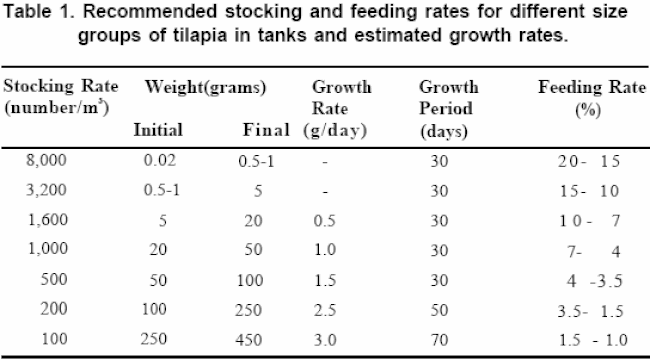
Stocking density, which is very high for fry, is decreased at regular intervals throughout the production cycle to reduce crowding, to ensure adequate water quality, and to use tank space efficiently (Table 1). It is not economical to pump water for a tank system that is stocked initially at one tenth of its capacity, which is the standard stocking practice for ponds. As density becomes too high, fish stocks can be split in half and physically moved to new tanks or given more space by adjusting screen partitions within the rearing tank. Rectangular tanks or raceways, in particular, are much easier to use and allow the culture of several size groups in one tank. However, fry and small fingerlings are cultured separately because they require better water quality. Each time that stocks are split and moved, they are graded through a bar grader to cull out about 10 percent of the slowest growing fish, which would probably not reach market size. Culls could be sold as baitfish if permitted by state law. Recommended grader widths are 25/64, 32/64, 44/64, and 89/64ths of an inch for tilapia greater than 5, 10,25, and 250 grams, respectively.
The highest mortality of the production cycle (about 20 percent) occurs during the fry rearing stage. Much of this is due to predation. As the fish grow and become hardier, mortality decreases significantly at each stage so that no more than 2 percent of the fish are expected to die during final grow-out.
Fry are given a complete diet of powdered feed (40 percent protein) that is fed continuously throughout the day with automatic feeders. The initial feeding rate, which can be as high as 20 percent of body weight per day under ideal conditions (good water quality and temperature: 86° F), is gradually lowered to 15 percent by day 30. During this period, fry grow rapidly and will gain close to 50 percent in body weight every 3 days. Therefore, the daily feed ration is adjusted every 3 days by weighing a small sample of fish in water on a sensitive balance. If feeding vigour diminishes, the feeding rate is cut back immediately and water quality (DO, pH, ammonia, nitrite) is checked.
Feed size can be increased to various grades of crumbles for fingerlings (1 to 50 grams), which also require continuous feeding for fast growth. During the grow-out stages, the feed is changed to floating pellets to allow visual observation of the feeding response. Recommended protein levels are 32 to 36 percent in fingerling feed and 28 to 32 percent in feed for larger fish. Adjustments in the daily ration can be made less often (eg, weekly) because relative growth, expressed as a percentage of body weight, gradually decreases to 1 percent per day as tilapia reach 1 pound in weight, although absolute growth in grams/day steadily increases.
The daily ration for adult fish is divided into three to six feedings that are evenly spaced throughout the day. If feed is not consumed rapidly (within 15 minutes), feeding levels are reduced. DO concentrations decline suddenly in response to feeding activity. Although DO levels generally decline during the day in tanks, feeding intervals provide time for DO concentrations to increase somewhat before the next feeding. Continuous feeding of adult fish favours the more aggressive fish, which guard the feeding area, and causes the fish to be less uniform in size. With high quality feeds and proper feeding techniques, the feed conversion ratio (fish weight gain divided by feed weight) should average 1.5 for a 1-pound fish.
Total production levels range from 3 to 6 pounds/ft3 of rearing space and 6 to 17 pounds/gallon/minute of flow. Monthly production levels range from 0.4 to 0.6 pounds/ft3. The higher production levels are generally obtained in flow-through systems. Production can always be increased by increasing the inputs, but this may not be economical.
Further articles from The Fish Site
Tilapia: life history and biology
Cage culture of tilapia
Pond culture Of tilapia
Source: Southern Regional Agricultural Center and the Texas Aquaculture Extension Service - December 2005
Words: James E Rakocy, University of the Virgin Islands