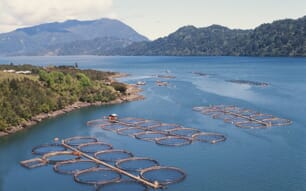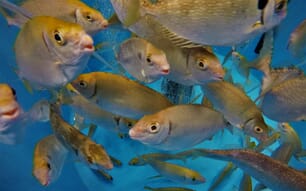
The Nile tilapia (O. niloticus) was one of the first fish species cultured. Illustrations from Egyptian tombs suggest that Nile tilapia were cultured more than 3,000 years ago. Tilapia have been called Saint Peter's fish in reference to biblical passages about the fish fed to the multitudes. The Nile tilapia is still the most widely cultured species of tilapia in Africa.
Positive aquacultural characteristics of tilapia are their tolerance to poor water quality and the fact that they eat a wide range of natural food organisms. Biological constraints to the development of commercial tilapia farming are their inability to withstand sustained water temperatures below 50 to 52oF and early sexual maturity that results in spawning before fish reach market size. Following is a discussion of the characteristics and culture of nonhybrid tilapia.
Taxonomy
Tilapia is the generic name of a group of cichlids endemic to Africa. The group consists of three aquaculturally important genera Oreochromis, Sarotherodon and Tilapia. Several characteristics distinguish these three genera, but possibly the most critical relates to reproductive behaviour. All tilapia species are nest builders; fertilised eggs are guarded in the nest by a brood parent. Species of both Sarotherodon and Oreochromis are mouth brooders; eggs are fertilised in the nest but parents immediately pick up the eggs in their mouths and hold them through incubation and for several days after hatching. In Oreochromis species only females practice mouth brooding, while in Sarotherodon species either the male or both male and female are mouth brooders.
During the last half century fish farmers throughout the tropical and semi-tropical world have begun farming tilapia. Today, all commercially important tilapia outside of Africa belong to the genus Oreochromis, and more than 90 percent of all commercially farmed tilapia outside of Africa are Nile tilapia. Less commonly farmed species are Blue tilapia (O. aureus), Mozambique tilapia (O. Mossambicus) and the Zanzibar tilapia (O. urolepis hornorum). The scientific names of tilapia species have been revised a lot in the last 30 years, creating some confusion. The scientific name of the Nile tilapia has been given as Tilapia nilotica, Sarotherodon niloticus, and currently as Oreochromis niloticus.
Physical characteristics
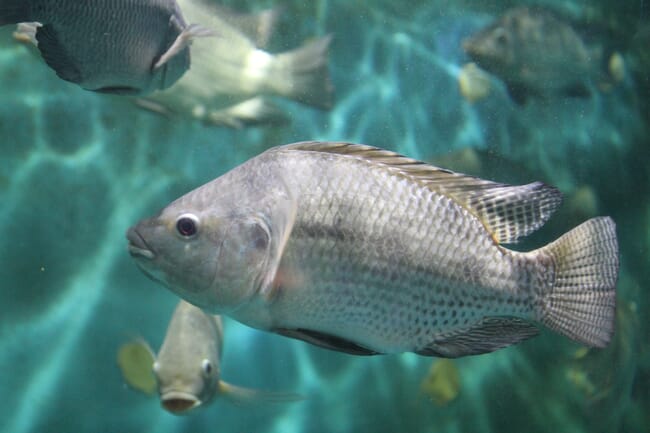
Tilapia are shaped much like sunfish or crappie but can be easily identified by an interrupted lateral line characteristic of the Cichlid family of fishes. They are laterally compressed and deep-bodied with long dorsal fins. The forward portion of the dorsal fin is heavily spined. Spines are also found in the pelvis and anal fins. There are usually wide vertical bars down the sides of fry, fingerlings, and sometimes adults.
© Shutterstock
Banding patterns and coloration
The main cultured species of tilapia usually can be distinguished by different banding patterns on the caudal fin. Nile tilapia have strong vertical bands, Blue tilapia have interrupted bands, and Mozambique tilapia have weak or no bands on the caudal fin. Male Mozambique tilapia also have upturned snouts. Colour patterns on the body and fins also may distinguish species. Mature male Nile tilapia have gray or pink pigmentation in the throat region, while Mozambique tilapia have a more yellow colouration. However, colouration is often an unreliable method of distinguishing tilapia species because environment, state of sexual maturity, and food source greatly influence colour intensity.
The red tilapia has become increasingly popular because its similar appearance to the marine red snapper gives it higher market value. The original red tilapias were genetic mutants. The first red tilapia, produced in Taiwan in the late 1960s, was a cross between a mutant reddish- orange female Mozambique tilapia and a normal male Nile tilapia. It was called the Taiwanese red tilapia. Another red strain of tilapia was developed in Florida in the 1970s by crossing a normal coloured female Zanzibar tilapia with a red-gold Mozambique tilapia.
A third strain of red tilapia was developed in Israel from a mutant pink Nile tilapia crossed with wild Blue tilapia. All three original strains have been crossed with other red tilapia of unreported origin or with wild Oreochromis species. Consequently, most red tilapia in the Americas are mosaics of uncertain origin. The confused and rapidly changing genetic composition of red tilapia, as well as the lack of head-to-head growth comparisons between the different lines, make it difficult for a producer to identify a best red strain. Other strains of tilapia selected for colour include true breeding gold and yellow Mozambique lines and a Rocky Mountain white tilapia (a true breeding line originating from an aberrant Blue tilapia, subsequently crossed with Nile tilapia). Most strains selected for colour do not grow well enough for food fish culture.
Identifying the species of an individual fish is further complicated by natural crossbreeding that has occurred between species. Electrophoresis is often used to determine the species composition of a group of tilapia.
Reproduction
In all Oreochromis species the male excavates a nest in the pond bottom (generally in water shallower than 3 feet) and mates with several females. After a short mating ritual the female spawns in the nest (about two to four eggs per gram of brood female), the male fertilises the eggs, and she then holds and incubates the eggs in her mouth (buccal cavity) until they hatch. Fry remain in the females mouth through yolk sac absorption and often seek refuge in her mouth for several days after they begin to feed.
Sexual maturity in tilapia is a function of age, size and environmental conditions. The Mozambique tilapia reaches sexual maturity at a smaller size and younger age than the Nile and Blue tilapias. Tilapia populations in large lakes mature at a later age and larger size than the same species raised in small farm ponds. For example, the Nile tilapia matures at about 10 to 12 months and 3/4 to 1 pound (350 to 500 grams) in several East African lakes. Under good growth conditions this same species will reach sexual maturity in farm ponds at an age of 5 to 6 months and 5 to 7 ounces (150 to 200 grams). When growth is slow, sexual maturity in Nile tilapia is delayed a month or two but stunted fish may spawn at a weight of less than 1 ounce (20 grams). Under good growing conditions in ponds, the Mozambique tilapia may reach sexual maturity in as little as 3 months of age, when they seldom weigh more than 2 to 4 ounces (60 to 100 grams). In poorly fertilised ponds sexually mature Mozambique tilapia may be as small as 1/2 ounce (15 grams).
Fish farming strategies that prevent overcrowding and stunting include:
- Cage farming where eggs fall through the mesh to the pond bottom before the female can collect them for brooding
- Polyculture with a predator fish, such as fingerling largemouth bass, at 400 per acre
- Culture of only males (monosex). All-male culture is desirable in ponds not only to prevent overpopulation and stunting but also because males grow about twice as fast as females.
Methods of obtaining predominately male fish include:
- Manually separating the sexes based on visual examination of the genital papilla of juvenile fish (hand-sexing)
- Hybridising between two selected species that produce all-male offspring (for example, Nile or Mozambique females crossed with Blue or Zanzibar males)
- Feeding a male hormone-treated feed to newly hatched fry for 3 to 4 weeks to produce reproductively functional males (sex reversal)
- YY male technology (currently under development and not yet a commercial option).
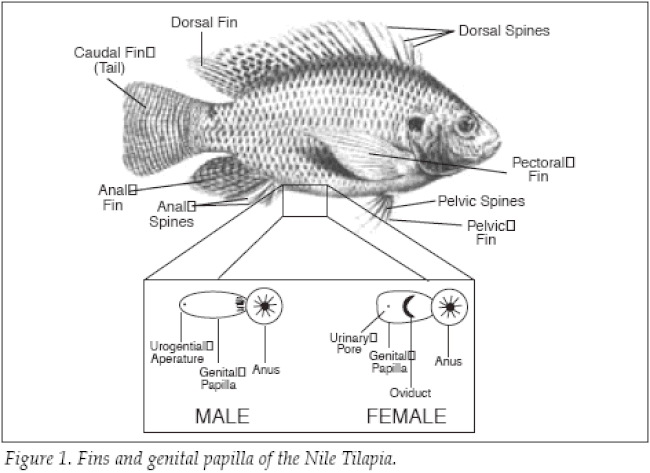
The sex of a 1-ounce (25-gram) tilapia fingerling can be determined by examining the genital papilla located immediately behind the anus (Fig 1). In males the genital papilla has only one opening (the urinary pore of the ureter) through which both milt and urine pass. In females the eggs exit through a separate oviduct and only urine passes through the urinary pore. Placing a drop of dye (methylene blue or food colouring) on the genital region helps to highlight the papilla and its openings.
Feeding behaviour and nutrition requirements
Tilapia ingest a wide variety of natural food organisms, including plankton, some aquatic macrophytes, planktonic and benthic aquatic invertebrates, larval fish, detritus, and decomposing organic matter. With heavy supplemental feeding, natural food organisms typically account for 30 to 50 percent of tilapia growth. (In supplementally fed channel catfish only 5 to 10 percent of growth can be traced to ingestion of natural food organisms.) Tilipia are often considered filter feeders because they can efficiently harvest plankton from the water.
However, tilapia do not physically filter the water through gill rakers as efficiently as true filter feeders such as gizzard shad and silver carp. The gills of tilapia secrete a mucous that traps plankton. The plankton-rich mucous, or bolus, is then swallowed. Digestion and assimilation of plant material occurs along the length of the intestine (usually at least six times the total length of the fish).
The Mozambique tilapia is less efficient than the Nile or Blue tilapia at harvesting planktonic algae. Two mechanisms help tilapia digest filamentous and planktonic algae and succulent higher plants:
- Physical grinding of plant tissues between two pharyngeal plates of fine teeth
- A stomach pH below 2, which ruptures the cell walls of algae and bacteria.
The commonly cultured tilapias digest 30 to 60 percent of the protein in algae; blue-green algae is digested more efficiently than green algae.
When feeding, tilapias do not disturb the pond bottom as aggressively as common carp. However, they effectively browse on live benthic invertebrates and bacteria-laden detritus. Tilapias also feed on midwater invertebrates. They are not generally considered piscivorous, but juveniles do consume larval fish.
In general, tilapias use natural food so efficiently that crops of more than 2,700 pounds of fish per acre (3,000 kg/ha) can be sustained in well-fertilised ponds without supplemental feed. The nutritional value of the natural food supply in ponds is important, even for commercial operations that feed fish intensively.
In heavily fed ponds with little or no water exchange, natural food organisms may provide one-third or more of total nutrients for growth. In general, tilapia digest animal protein in feeds with an efficiency similar to that of channel catfish, but are more efficient in the digestion of plant protein, especially more fibrous materials.
Tilapia require the same ten essential amino acids as other warm water fish, and, as far as has been investigated, the requirements for each amino acid are similar to those of other fish. Protein requirements for maximum growth are a function of protein quality and fish size and have been reported as high as 50 percent of the diet for small fingerlings. However, in commercial food fish ponds the crude protein content of feeds is usually 26 to 30 percent, one tenth or less of which is of animal origin. The protein content and proportion of animal protein may be slightly higher in recirculating and flow-through systems.
The digestible energy requirements for economically optimum growth are similar to those for catfish and have been estimated at 8.2 to 9.4 kcal DE (digestible energy) per gram of dietary protein. Tilapia may have a dietary requirement for fatty acids of the linoleic (n-6) family. Tilapia appear to have similar vitamin requirements as other warm water fish species. Vitamin and mineral premixes similar to those added to catfish diets are usually incorporated in commercial tilapia feeds. The feeding behaviour of tilapia allows them to use a mash (unpelleted feeds) more efficiently than do catfish or trout, but most commercial tilapia feeds are pelletised to reduce nutrient loss. In the absence of feeds specifically prepared for tilapia, a commercial catfish feed with a crude protein content of 28 to 32 percent is appropriate in the United States.
Environmental requirements
Tilapia are more tolerant than most commonly farmed freshwater fish to high salinity, high water temperature, low dissolved oxygen, and high ammonia concentrations.
Salinity
All tilapia are tolerant to brackish water. The Nile tilapia is the least saline tolerant of the commercially important species, but grows well at salinities up to 15 ppt. The Blue tilapia grows well in brackish water up to 20 ppt salinity, and the Mozambique tilapia grows well at salinities near or at full strength seawater. Therefore, the Mozambique tilapia and some mossambicusderived red tilapia are preferred for saltwater culture. Some lines of the Mozambique tilapia reportedly have spawned in full strength seawater, but its reproductive performance begins to decline at salinities above 10 to 15 ppt. The Blue and Nile tilapias can reproduce in salinities up to 10 to 15 ppt, but perform better at salinities below 5 ppt. Fry numbers decline substantially at 10 ppt salinity.
Water temperature
The intolerance of tilapia to low temperatures is a serious constraint for commercial culture in temperate regions. The lower lethal temperature for most species is 50 to 52o F for a few days, but the Blue tilapia tolerates temperatures to about 48o F.
Tilapia generally stop feeding when water temperature falls below 63o F. Disease-induced mortality after handling seriously constrains sampling, harvest and transport below 65o F.
Reproduction is best at water temperatures higher than 80o F and does not occur below 68o F. In subtropical regions with a cool season, the number of fry produced will decrease when daily water temperature averages less than 75o F. After 16 to 20 day spawning cycles with 1/2-pound Nile tilapia, fry recovery was about 600 fry per female brooder at a water temperature of 82o F, but only 250 fry per female at 75o F.
Optimal water temperature for tilapia growth is about 85 to 88o F. Growth at this optimal temperature is typically three times greater than at 72o F.
Dissolved oxygen concentration
Tilapia survive routine dawn dissolved oxygen (DO) concentrations of less than 0.3 mg/L, considerably below the tolerance limits for most other cultured fish. In research studies Nile tilapia grew better when aerators were used to prevent morning DO concentrations from falling below 0.7 to 0.8 mg/L (compared with unaerated control ponds). Growth was not further improved if additional aeration kept DO concentrations above 2.0 to 2.5 mg/L. Although tilapia can survive acute low DO concentrations for several hours, tilapia ponds should be managed to maintain DO concentrations above 1 mg/L. Metabolism, growth and, possibly, disease resistance are depressed when DO falls below this level for prolonged periods.
pH
In general, tilapia can survive in pH ranging from 5 to 10 but do best in a pH range of 6 to 9.
Ammonia
Massive mortality of tilapia occurs within a few days when fish are suddenly transferred to water with un-ionised ammonia concentrations greater than 2 mg/L. However, when gradually acclimated to sublethal levels, approximately half the fish will survive 3 or 4 days at un-ionised ammonia concentrations as high as 3 mg/L.
Prolonged exposure (several weeks) to un-ionised ammonia concentration greater than 1 mg/L causes losses, especially among fry and juveniles in water with low DO concentration. The first mortalities from prolonged exposure may begin at concentrations as low as 0.2 mg/L. Un-ionised ammonia begins to depress food consumption at concentrations as low as 0.08 mg/L.
Nitrite
Nitrite is toxic to many fish because it makes the haemoglobin less capable of transporting oxygen; chloride ions reduce the toxicity. Tilapia are more tolerant of nitrite than many cultured freshwater fish. When dissolved oxygen concentration was high (6 mg/L) and chloride concentration was low (22 mg/L), the nitrite concentration at which 50 percent of the fish died in 4 days was 89 mg/L as nitrite.
In general, for freshwater culture the nitrite concentration should be kept below 27 mg/L as nitrite. As a safeguard against nitrite toxicity in recirculating systems, chloride concentrations are often maintained at 100 to 150 mg/L chloride.
Diseases
Tilapia are more resistant to viral, bacterial and parasitic diseases than other commonly cultured fish, especially at optimum temperatures for growth. Lymphocystis, columnaris, whirling disease, and hemorrhagic septicemia may cause high mortality, but these problems occur most frequently at water temperatures below 68o F. Ich, caused by the protozoan Ichthyopthirius multifiliis, can cause serious losses of fry and juveniles in intensive recirculating systems. External protozoans such as Trichodina and Epistylis also may reach epidemic densities on stressed fry in intensive culture. In recent years the bacterial infection Steptococcus inae has caused heavy losses, primarily in recirculating and intensive flow-through systems.
Growth and yields in aquaculture
Under good growth conditions, 1-gram fish are cultured in nursery ponds to 1 to 2 ounces (20 to 40 grams) in 5 to 8 weeks and then restocked into grow-out ponds. In monosex grow-out ponds under good temperature regimes, males generally reach a weight of 1/2 pound (200 + grams) in 3 to 4 months, 1 pound (400 + grams) in 5 to 6 months, and 1.5 pounds (700 grams) in 8 to 9 months.
To produce 1-pound (400- to 500-gram) fish, common practice is to stock 6,000 to 8,000 males per acre in static water ponds with aeration or 20,000 to 28,000 males per acre where 20 percent daily water exchange is economically practical.
After 6 months of feeding with good quality feeds, such ponds can produce 5,000 to 7,000 pounds per acre and 18,000 to 20,000 pounds per acre, respectively. If grow-out cycles are longer than 5 to 6 months (in an attempt to produce a more marketable size fillet) there is a risk that offspring from reproduction of the few females that were unintentionally included in the all-male culture will have time to reach sexual maturity and overpopulate the pond.
Consequently, a farmer who wishes to produce fish yielding 5-ounce fillets (a 2-pound fish) is often forced to add a second grow-out phase so females and fingerlings can be eliminated from the grow-out ponds, or to stock a predaceous fish with the males.
Dressout percentage on tilapia is relatively low compared to species such as trout and catfish. Tilapia generally have a dressout of 51 to 53 percent of live weight for whole-dressed fish (head-off) and 32 to 35 percent for fillets (pin bones along the lateral line removed). For additional information about tilapia culture see SRAC publications 280, 281 and 282.
Regulations
Tilapias are native only to Africa; many states in the US consider them exotics or non-indigenous species and have restricted their transport and culture. Prospective tilapia producers should check with state game and fish/natural resources agencies or with Extension fisheries/aquaculture specialists to determine legal implications.
Conclusions
Tilapia are a good fish for warm water aquaculture. They are easily spawned, use a wide variety of natural foods as well as artificial feeds, tolerate poor water quality, and grow rapidly at warm temperatures.
These attributes, along with relatively low input costs, have made tilapia the most widely cultured freshwater fish in tropical and subtropical countries. Consumers like tilapias firm flesh and mild flavor, so markets have expanded rapidly in the US during the last 10 years, mostly based on foreign imports. In fact, tilapia sales have recently surpassed rainbow trout sales in the US.
Further Articles
Tank Culture Of Tilapia
Source: Southern Regional Agricultural Center and the Texas Aquaculture Extension Service - Taken from site - December 2005