Despite Atlantic cod and haddock extending further into Arctic waters, a new study reveals there is little competition for food between the invaders and native polar cod. However, it is uncertain whether climate change will increase competition between...
Asian carp, that large, invasive fish known for leaping out of a river into boats when startled, now make up more than 60 percent of the total fish biomass in one of Illinois' major river systems, a research team led by Southern Illinois University Carbondale...
With the reproductivity of farmed fish a major concern for the aquaculture industry, the Genetics and Reproduction Group at the Institute of Aquaculture, Stirling, Scotland, has carried out research to tackle common problems including sexual maturation...
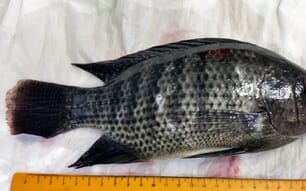
Tilapia breeding is profitable only if it is solely focused on male populations. Hormonal inversion methods currently used to produce these populations have, however, many drawbacks. CIRAD has been investigating a genetic approach for several years and...
For the last three years, the University of Arkansas at Pine has partnered with The University of Tennessee and Texas A&M University on a project funded by the USDA’s Southern Regional Aquaculture Center to develop croakers as an inland, low-salinity marine...
With sea lice being a major challenge for the salmon industry, at Aquaculture Europe 2011, Herve Migaud from the University of Stirling looked at what factors are limiting wrasse production. Charlotte Johnston, TheFishSite editor reports.
The availability of the required quantities of high value marine fin fish seed is the major prerequisite for the initiation and expansion of fin fish mariculture.
A glance at the sex organs in the body cavity of a fish reveals both its sex and maturity.
Scientists from the Instituto Español de Oceanografía (IEO) have once again obtained viable bluefin tuna spawnings in their facilities in Murcia without the need for hormonal induction.
A study led by scientists at the University of Valencia (Spain) characterizes eleven zebra mussel populations in the Ebro and the Júcar River Basin District and concludes that the arrival of this exotic species to Spanish river basins is "virtually irreversible"....
Information on the Pullet Carpet Shell from the FAO Cultured Aquatic Species Information Programme.
Information on the Mandarin Fish from the FAO Cultured Aquatic Species Information Programme.
Information on the Gilthead Seabream from the FAO Cultured Aquatic Species Information Programme.
Information on the culture of the Japanese amberjack from the FAO Cultured Aquatic Species Information Programme.
Herve Migaud, John Taylor and Andrew Davie from the University of Stirling Aquaculture look at the impact of reproduction research.


© 2000 - 2012. 5m Publishing, Benchmark House, 8 Smithy Wood Drive, Sheffield, S35 1QN, England. - A Benchmark Holdings Ltd. Company